VIP Guard
- 4.7
- Rating
- 10.00M
- Installs
- Free
- Price

 Analysis by App-foxy
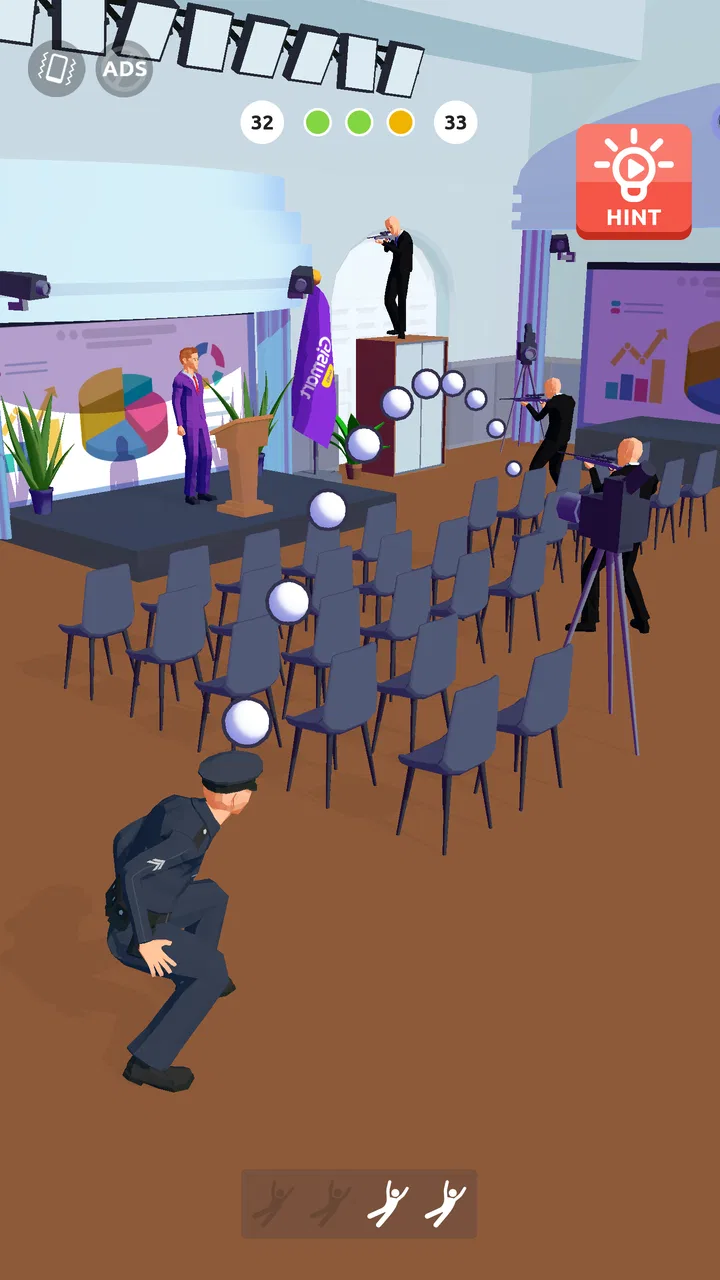
VIP Guard is the kind of arcade game I open when I want a quick challenge with an immediately understandable goal: keep the president alive by stepping into the path of incoming bullets. Developed by Gismart, it turns the familiar “human shield” idea into short shooting-game encounters where timing matters more than complicated controls.
That simple premise is also the reason it is easy to start playing. I do not need to learn a large map, manage a long inventory, or remember a complicated story. The central question is always direct: can I position the guard quickly enough to protect the target? When I have only a few spare minutes, that clarity works in its favor.
The game is free to download and sits in the arcade category, with optional in-app purchases priced from $3.49 to $4.99 per item. It carries a Teen content rating, so I would not treat it as a game for very young children despite its cartoon-like, accessible presentation. The current version is 1.2.32, and it runs on Android 7.1 or later. On iOS, the practical experience will depend on the device and system version available through the relevant store.
You May Also Like

 Blood Strike: 2.5 Anniversary
Blood Strike’s Loadouts Turn Every Drop Into a Tactical Gamble
A close look at Blood Strike’s custom loadouts: how fast access to signature weapons reshapes its battle royale rhythm, rewards preparation, and narrows the gap between fights.

 Pandora - Music & Podcasts
Pandora’s Music Is Easy to Start, but Harder to Recover
Pandora’s strength is its low-effort path from a seed to a station. Its weak spot is how much confidence it asks you to place in connection, setup, and quiet recovery.

 8 Ball Pool
 Is Built on Rivalries, Rematches, and Routine
A close look at the rivalries, rematches, shared routines, and unanswered safety questions that turn a quick pool match into a persistent mobile community.

 Samsung Music
’s Quiet Strength Is Playing What You Already Own
Its reach comes less from spectacle than from dependable access to a personal library. That simplicity is both the app’s strongest retention engine and its ceiling.

 AccuWeather: Weather Radar
AccuWeather Review: A Quick, Clear Forecast for Everyday Decisions
For everyday plans, the best forecast is the one you can understand quickly. AccuWeather makes rain timing, radar, and local conditions easy to act on, with a few trade-offs.

 Hill Climb Racing
Why Hill Climb Racing Still Turns Crashes Into One More Run
A tiny car, a bumpy hill and one more upgrade: Hill Climb Racing keeps resurfacing because its simple chaos makes every near-miss feel personal.
More From Our News Desk



How the basic protection loop feels in practice
My first useful habit was to stop thinking of each encounter as a reflex test alone. The obvious impulse is to move as soon as I see danger, but rushing can put the guard in the wrong place. I get better results by identifying the direction of the threat, estimating where the protected character will remain exposed, and then making one deliberate movement rather than several nervous corrections.
That makes the game more interesting than its short description suggests. The controls are approachable, but the pressure comes from reading the scene quickly. A player who reacts without looking can fail even when the required action seems obvious. Conversely, someone who watches the whole setup for a moment often has enough time to choose a safer position.
I found the basic workflow particularly suitable for short sessions. I can play while waiting for an appointment or during a brief break, complete a few attempts, and stop without feeling that I have abandoned a lengthy campaign. There is no need to reserve a large block of time for it. That convenience is one of its strongest everyday qualities.
A realistic example is a commute where I have only a few minutes before reaching my stop. I can launch the game, focus on a handful of protection scenes, and put it away without needing to remember a complex objective. The trade-off is that the same compact structure may feel repetitive to anyone looking for exploration, character development, or a substantial narrative.
The president-protection theme gives every attempt a clear priority. I am not simply trying to survive for an abstract score; I am trying to place myself between danger and the VIP. That small change in framing helps the action feel purposeful, even though the overall format remains lightweight arcade entertainment.
The first habit that improves consistency
I recommend keeping the guard’s position in mind before concentrating on the bullet itself. In a fast scene, the projectile attracts attention, but the important question is where the protected character is vulnerable. Looking at both points turns the task into a line-of-defense problem. This is more reliable than following the projectile with frantic movements.
Another useful habit is to avoid treating every attempt as a failure if the result is not perfect. I use early runs to learn how much movement is actually needed. Once I understand the pace of a particular situation, I make smaller corrections and preserve more control. That approach is especially helpful for players who normally find reflex games stressful.
The game does not require me to master a large collection of buttons, which makes it approachable for casual players. However, approachable does not mean effortless. The challenge comes from the timing and positioning inside each encounter, so a player who wants entirely passive entertainment will probably lose interest quickly.
What I would check before settling into longer sessions
The most important practical check is whether the game’s free-to-play structure suits my expectations. It is free to start, but optional purchases are available, with individual items ranging from $3.49 to $4.99. I would review the purchase prompts carefully and make sure the device’s purchase controls are configured appropriately, especially if children or other family members use the same phone or tablet.
I also pay attention to the age guidance. The Teen rating is worth taking seriously because the central action involves bullets and protecting a public figure. The presentation may be easy to understand, but that does not automatically make it suitable for every child. For a family device, I would choose another game if the intended player is below the recommended age.
On Android, the minimum requirement of version 7.1 or later means older devices may not be compatible. That is a simple detail, but it matters when someone is trying to install the game on a spare phone. I would check the operating system before spending time troubleshooting an installation that the device cannot support.
The version number, 1.2.32, is useful when checking whether the installed copy is current. I do not treat a version label as a guarantee of performance, though. Older or less powerful hardware can still affect loading, touch response, and general comfort. For a game built around quick reactions, a screen that feels slow or inconsistent can make the experience seem harder than it really is.
There is also a settings-related habit that experienced players often overlook: I make sure the screen is clean and hold the device in a way that leaves my main control area unobstructed. That is not a special feature of the game, but it has a direct effect on precision. A small amount of friction at the touch point matters more in a positioning game than it does in a turn-based title.
Why device setup matters more here than in slower games
In a puzzle game with unlimited time, a brief touch delay is annoying but manageable. In VIP Guard, a delayed or imprecise movement can change the outcome of an entire scene. I therefore prefer playing with a stable grip, adequate battery, and notifications silenced when possible. These are ordinary preparation steps, but they reduce distractions and make the challenge feel fairer.
I would also avoid playing while walking or doing another task. The game looks simple enough to invite distracted use, yet the core challenge depends on watching the screen and responding at the right moment. It is better suited to a short, focused pause than to multitasking.
Repeatable patterns that make attempts less wasteful
Once I became comfortable with the basic loop, I started using a repeatable scan. First I locate the VIP, then I check the likely path of the threat, and finally I choose the shortest movement that creates protection. This three-step rhythm is faster than reacting to the most visually dramatic object on screen.
The key trade-off is speed versus precision. Moving early gives me more time, but an unnecessary early move can leave the guard poorly positioned. Moving late may be more accurate in theory, but it leaves less room for correction. I usually prefer a controlled early placement when the direction is clear, then a small adjustment only if the scene demands it.
This is where the game rewards calm repetition. I do not need to memorize a huge system; I need to recognize the shape of the immediate problem. After a few attempts, I become better at separating genuine danger from visual noise and at choosing a position that protects the VIP without overworking the controls.
Another practical technique is to treat a failed attempt as information about timing rather than as a reason to change everything. If the guard moved too late, I adjust the start of the movement. If the position was wrong, I change the destination. Making one correction at a time helps me understand what caused the failure instead of replacing a clear plan with random motion.
That approach is useful for younger or less experienced arcade players too, although the Teen rating remains relevant. The game can teach patience and visual prioritization, but the bullet-based premise may still be inappropriate for some households. Parents should decide based on the rating and the individual player, not only on the simplicity of the controls.
Where it differs from familiar arcade alternatives
Compared with endless runners, VIP Guard feels more situational. An endless runner typically asks me to keep moving through a continuous route, while this game focuses my attention on protecting a specific target during an individual danger sequence. That makes it better for players who enjoy a clear objective and less appealing to people who prefer a constant flow of movement.
It also differs from conventional shooting games. I am not primarily trying to attack opponents or build a weapon loadout. My role is defensive, and the most important action is placing the bodyguard correctly. Players who want extensive equipment choices, tactical maps, or a deep competitive system should look elsewhere.
Compared with slower puzzle games, the appeal here is immediacy. There is less time to calculate, and the satisfaction comes from reading the scene quickly. The downside is that the game offers less room for relaxed experimentation. If I want a quiet experience that I can pause while thinking, a traditional puzzle title is a better fit.
The game’s large audience suggests that this compact format has broad appeal: it has a 4.7 average from around 248 thousand ratings and more than 10 million installs. I see those figures as evidence that the concept is easy for many people to understand, not as a promise that every player will enjoy its repetition or purchase structure.
Limits that become clearer with extended play
The same focused loop that makes the game convenient can become its biggest limitation. After several sessions, I may want more variety in objectives or a stronger sense of progression. If the main pleasure for me is discovering new systems, building a character, or exploring a world, the protective arcade format will feel narrow.
I am also conscious of the free-to-play context. Even when I intend to spend nothing, purchase options can change how I think about the session. I prefer to decide in advance whether I am playing strictly as a free user and to avoid making an impulse purchase simply because I have failed several times in a row.
That is not a criticism of having optional purchases by itself. It is a reminder that the game works best when I approach it as a short arcade diversion rather than as an endless progression project. If I expect a complete premium-style experience with no commercial interruptions, I would choose a paid game instead.
There is also a skill ceiling created by the simplicity of the controls. At first, improving reaction and positioning feels rewarding. Later, once the basic habits are established, my enjoyment depends heavily on how much variation I perceive from one encounter to the next. Players who value mechanical refinement can still appreciate the timing, but those who need constant novelty may reach the limit sooner.
For that reason, I would not recommend it as the only game on a long trip unless I already know that I enjoy short, repeatable arcade challenges. It works better alongside other games: perhaps one session for quick reactions, followed by a slower title for exploration or strategy. That combination respects what VIP Guard does well without asking it to provide an experience it was not designed to deliver.
Who should try it and who should skip it
I would recommend VIP Guard to someone who likes simple controls, fast decisions, and objectives that can be understood immediately. It is especially suitable for casual players who want a game that can be picked up without a tutorial-heavy commitment. The defensive role also gives the action a distinctive flavor compared with ordinary target-shooting games.
I would be more cautious about recommending it to players who dislike retrying short scenes, become frustrated by reaction-based challenges, or expect deep long-term progression. The game asks for attention but does not provide the broad strategic toolkit found in more substantial arcade or action titles.
I would also skip it for a child who falls below the Teen guidance, even if the controls seem easy. For an older player who enjoys the theme and understands the purchase options, it can be a harmless way to fill a few minutes, provided the device is compatible and the player is comfortable with the free-to-play model.
My final take after building a consistent routine
After using a deliberate scan, limiting unnecessary movements, and treating failed attempts as timing feedback, I found the game more satisfying than a quick glance might suggest. Its strongest quality is not complexity; it is the clean connection between what I see and what I must do. Protecting the VIP gives each scene a readable purpose, while the arcade structure keeps the commitment small.
My recommendation comes with clear boundaries. I would install it for short sessions, not for a deep campaign. I would check the Teen rating, confirm that the device runs Android 7.1 or later when relevant, and keep the optional purchases in mind. I would also play with a focused grip rather than expecting it to work well as a distracted background activity.
Gismart has made a compact game that is easy to understand but still rewards better habits: scan before moving, prioritize the protected character, and correct one mistake at a time. The result is a decent choice for quick arcade entertainment, especially when I want a defensive twist instead of endless running or conventional shooting.
In my experience, VIP Guard is at its best when I treat it as a focused five-minute challenge rather than a full-time hobby. If that sounds like the kind of game you want, its free entry point makes it easy to try. If you need rich progression, extensive customization, or a calmer pace, another category will serve you better.
FAQs for VIP Guard
01What is VIP Guard and what are its main features?
VIP Guard is an engaging action-strategy game where players take on the role of a bodyguard protecting a VIP from various threats. Key features include strategic gameplay, a variety of levels, unique obstacles, and customization options for upgrading your guard’s abilities. The game offers a blend of quick decision-making and tactical planning.
02Is VIP Guard free to play, or does it require in-app purchases?
VIP Guard is free to download and play, but it includes optional in-app purchases. These purchases can enhance gameplay by offering items like additional lives, special abilities, or cosmetic upgrades. While these purchases can provide a more enriched experience, they are not necessary to enjoy the game fully.
03What are the system requirements for VIP Guard on Android and iOS?
For Android, VIP Guard typically requires a device running Android 5.0 or higher, with at least 1GB of RAM for optimal performance. On iOS, the game requires iOS 10.0 or later, compatible with iPhone, iPad, and iPod touch. These requirements ensure smooth gameplay and access to all features.
04How does VIP Guard handle user data and privacy?
VIP Guard adheres to strict privacy policies to protect user data. It may collect information such as device type and gameplay statistics to enhance user experience. However, personal data like email addresses or social media profiles are only collected with user consent. Always review the privacy policy before downloading.
05Can VIP Guard be played offline, or is an internet connection required?
VIP Guard primarily requires an internet connection to access certain features like leaderboards and in-app purchases. However, many levels and the core gameplay can be enjoyed offline. Playing offline may limit some functionalities, but it allows for uninterrupted gameplay in areas without internet access.
Pros
- Engaging gameplay with strategic elements.
- Colorful graphics enhance the visual experience.
- Easy controls suitable for all ages.
- Regular updates with new levels and challenges.
- Multiplayer mode adds competitive fun.
Cons
- In-app purchases can be pricey.
- Occasional ads disrupt gameplay.
- Some levels feel repetitive.
- Requires internet connection to play.
- Limited customization options for characters.

VIP Guard
Gallery